![[photo, Young musicians, Baltimore Farmers' Market, near Holliday St., Baltimore, Maryland]](/msa/mdmanual/01glance/music/images/1198-1-06004b.jpg)
![[photo, Park Elementary School, 201 East 11th Ave., Brooklyn Park, Maryland]](/msa/mdmanual/36loc/an/images/1198-1-4481
.jpg) One of the primary education journals in the nation, Education Week in 2015 ranked Maryland the number three public school system in America. One part of the ranking - the "Quality Counts" survey - ranks states based upon school financing, achievement, and "the chance of success" for children. Maryland ranked first from 2009 to 2013 [no rankings were made in 2014] and third in 2015.
One of the primary education journals in the nation, Education Week in 2015 ranked Maryland the number three public school system in America. One part of the ranking - the "Quality Counts" survey - ranks states based upon school financing, achievement, and "the chance of success" for children. Maryland ranked first from 2009 to 2013 [no rankings were made in 2014] and third in 2015.
In 2016, U.S. News & World Report ranked Maryland first in the nation for "Best High Schools" for the second year in a row. Nearly 29% of qualified schools earned the publication's gold and silver medals, which ranks each school on college preparation.
Park Elementary School, 201 East 11th Ave., Brooklyn Park, Maryland, August 2010. Photo by Diane F. Evartt.
![[photo, Margaret Brent Elementary School, 100 East 26th St., Baltimore, Maryland]](/msa/mdmanual/36loc/bcity/images/1198-1-3977.jpg) Maryland also led the nation in Newsweek Magazine's 2010 "America's Best High Schools" issue. Maryland ranked first for the second year in a row, with 53% of the State's high schools making the list, up from 29.5% of schools in 2009. Ranking is based on student participation in Advanced Placement and International Baccalaureate tests.
Maryland also led the nation in Newsweek Magazine's 2010 "America's Best High Schools" issue. Maryland ranked first for the second year in a row, with 53% of the State's high schools making the list, up from 29.5% of schools in 2009. Ranking is based on student participation in Advanced Placement and International Baccalaureate tests.
In addition, Maryland's high school graduation rates have been rising steadily. As of June 2015, 86.98% of high school students graduate. At the same time, the dropout rate now is the lowest on record, 8.08%.
Margaret Brent Elementary School, 100 East 26th St., Baltimore, Maryland, July 2009. Photo by Diane F. Evartt.
![[photo, Annapolis Elementary School, 180 Green St., Annapolis, Maryland]](/msa/mdmanual/37mun/annapolis/images/1198-1-5895b
.jpg) In 2015, six Maryland public schools were selected as National Blue Ribbon Schools; and two others, as well as the Howard County School System, were named National Green Ribbon Schools. In 2014, Maryland was awarded a federal grant that gives $15 million annually to improve access to quality pre-kindergarten programs. The grant extends through FY2019.
In 2015, six Maryland public schools were selected as National Blue Ribbon Schools; and two others, as well as the Howard County School System, were named National Green Ribbon Schools. In 2014, Maryland was awarded a federal grant that gives $15 million annually to improve access to quality pre-kindergarten programs. The grant extends through FY2019.
In 2010, Maryland was one of eight states awarded additional federal grants for education in round two of the Race to the Top program.
Annapolis Elementary School, 180 Green St., Annapolis, Maryland, November 2011. Photo by Diane F. Evartt.
![[photo, Severna Park Elementary School, 6 Riggs Ave., Severna Park, Maryland]](/msa/mdmanual/36loc/an/images/1198-1-4255
.jpg) Maryland students ranked first in the nation on Advanced Placement (AP) Exams from 2008 to 2015, and second in 2016. The standard is based on the percentage of students taking the AP exam, as well as the percentage of those students who scored a 3 or higher, out of 5. In Maryland, some 30.4% of the 2016 graduating class took and passed at least one content exam. This is compared to the nationwide average of 21.9%.
Maryland students ranked first in the nation on Advanced Placement (AP) Exams from 2008 to 2015, and second in 2016. The standard is based on the percentage of students taking the AP exam, as well as the percentage of those students who scored a 3 or higher, out of 5. In Maryland, some 30.4% of the 2016 graduating class took and passed at least one content exam. This is compared to the nationwide average of 21.9%.
Severna Park Elementary School, 6 Riggs Ave., Severna Park, Maryland, September 2009. Photo by Diane F. Evartt.
![[photo, Baltimore School for the Arts, 712 Cathedral St., Baltimore, Maryland]](/msa/mdmanual/36loc/bcity/images/1198-1-3987.jpg) In Maryland, public education is a responsibility shared by State, county and Baltimore City government. The State Board of Education sets educational standards, certifies teachers, partially funds school construction and instruction, and monitors school performance. The Board also oversees the State Department of Education. County boards of education often set additional requirements, develop new programs, and provide substantial local funding.
In Maryland, public education is a responsibility shared by State, county and Baltimore City government. The State Board of Education sets educational standards, certifies teachers, partially funds school construction and instruction, and monitors school performance. The Board also oversees the State Department of Education. County boards of education often set additional requirements, develop new programs, and provide substantial local funding.
Baltimore School for the Arts, 712 Cathedral St., Baltimore, Maryland July 2009. Photo by Diane F. Evartt.
![[photo, Paul Laurence Dunbar Middle School, 500 North Caroline St., Baltimore, Maryland]](/msa/mdmanual/36loc/bcity/images/1198-1-2717.jpg) Federal, State and local funds combined to provide $12.1 billion for Maryland public schools with an average cost per pupil of $13,745 in Fiscal Year 2014. Of these funds, local government appropriated the greatest amount ($5,696,674,801), followed by State government ($5,822,527,353), and federal government ($582,089,355).
Federal, State and local funds combined to provide $12.1 billion for Maryland public schools with an average cost per pupil of $13,745 in Fiscal Year 2014. Of these funds, local government appropriated the greatest amount ($5,696,674,801), followed by State government ($5,822,527,353), and federal government ($582,089,355).
The Maryland school year is a minimum of 180 days long. Schools are open for a ten-month period, from about Labor Day to mid-June. Opening and closing dates vary from county to county. Elementary and middle school students attend school at least 6 hours a day, high school students 6.5 hours a day.
Kindergarten is mandatory for children who are five years of age by September 1. State law also requires that children, ages 5 to 16, attend school. Effective July 1, 2017, children will be required to attend school until age 18 (Chapter 494, Acts of 2012). Students may attend school up to age 21.
Paul Laurence Dunbar Middle School, 500 North Caroline St., Baltimore, Maryland, April 2008. Photo by Diane F. Evartt.
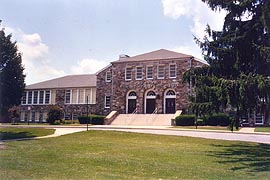 In September 2014, for pre-kindergarten through high school, 874,514 students enrolled in 1,447 public schools, and 126,679 students enrolled at 1,397 private schools. Public high schools graduated 57,560 students in 2015. Those intending to continue their education: 86.1% (84.1% in a college or university, 2% in a trade or business school); work: 17.8%; or enter military service: 3.7%.
Prettyboy Elementary School, 19810 Middletown Road, Freeland (Baltimore County), Maryland, July 2006. Photo by Diane F. Evartt.
![[photo, Brooklyn Park Middle School, 200 Hammonds Lane, Brooklyn Park, Maryland]](/msa/mdmanual/01glance/images/1198-1-642.jpg) More stringent requirements for graduation from high school were set by the State in 1992. Credits required were increased from 20 to 21. General requirements were replaced with particular courses, or courses with specific content. Fewer credits were reserved for electives (nonrequired courses chosen by students). Since the graduating class of 2009, students have been required to take and pass the Maryland High School Assessment exams in algebra and data analysis, biology, and english in order to graduate. They also must perform 75 hours of volunteer community service approved by the State.
More stringent requirements for graduation from high school were set by the State in 1992. Credits required were increased from 20 to 21. General requirements were replaced with particular courses, or courses with specific content. Fewer credits were reserved for electives (nonrequired courses chosen by students). Since the graduating class of 2009, students have been required to take and pass the Maryland High School Assessment exams in algebra and data analysis, biology, and english in order to graduate. They also must perform 75 hours of volunteer community service approved by the State.
Brooklyn Park Middle School, 200 Hammonds Lane, Brooklyn Park (Anne Arundel County), Maryland, January 2004. Photo by Diane F. Evartt.
![[photo, George Fox Middle School, 7922 Outing Ave, Pasadena, Maryland]](/msa/mdmanual/36loc/an/images/1198-1-07842c.jpg) In June 2010, the State Board of Education adopted the Common Core State Standards, coordinated by the National Governors Association and the Council of Chief State School Officers. These new educational standards are set to ensure that students nationwide receive the same quality education to prepare them for higher education and the workforce. Since 2010, Maryland educators have worked to develop a State curriculum in English language arts and mathematics that adheres to the Standards. In the 2012-2013 school year, the new Maryland Common Core State Curriculum was field-tested, and for the 2013-2014 school year was implemented statewide. To evaluate its effectiveness, new assessments were needed to replace the High School Assessments.
In June 2010, the State Board of Education adopted the Common Core State Standards, coordinated by the National Governors Association and the Council of Chief State School Officers. These new educational standards are set to ensure that students nationwide receive the same quality education to prepare them for higher education and the workforce. Since 2010, Maryland educators have worked to develop a State curriculum in English language arts and mathematics that adheres to the Standards. In the 2012-2013 school year, the new Maryland Common Core State Curriculum was field-tested, and for the 2013-2014 school year was implemented statewide. To evaluate its effectiveness, new assessments were needed to replace the High School Assessments.
George Fox Middle School, 7922 Outing Ave, Pasadena (Anne Arundel County), Maryland, September 2016. Photo by Diane F. Evartt.
Special Public School Programs. These cover pre-kindergarten for four-year olds; and career and technology education, including consumer and homemaking classes. Gifted and talented programs also are offered by the State, on a tuition basis, at summer centers for students who qualify academically, meet geographical distribution requirements, and are able to pay the cost.
Special education services for students with disabilities range from aid for part or all of a school day to specialized services for homebound students or those in separate facilities or hospitals. Within the State Department of Education, the Division of Special Education and Early Intervention Services administers both State and federal programs for special education.
© Copyright Maryland State Archives